

Post-Grant Opposition in Japan (JPO): Who Can File, Deadlines, and the Opponent’s Role
2026.11.27

Tatsuyuki TSUBO
If a competitor obtains a patent in Japan and you believe that the patent should not have been granted, you can ask the Japan Patent Office (JPO) to review it through a post-grant opposition (officially, “opposition to grant of patent”). It is broadly comparable to the EPO opposition and the US post-grant review (PGR), and is the most accessible way to challenge a Japanese patent shortly after grant. Any person may file an opposition, even without a legal interest in the patent, and the official fees are low compared with similar procedures in Europe and the United States.
However, an opposition must be filed within six months from the publication date of the patent gazette, and the opponent has only limited opportunities to take part in the proceedings after filing. This article explains the filing requirements and the opponent’s role after filing, for readers who are considering an opposition against a Japanese patent.
- Who: Any person may file. Anonymous filing is not permitted, but an opposition may be filed in the name of a third party
- When: Within six months from the publication date of the patent gazette
- Grounds: Lack of novelty, lack of inventive step, description requirements, new matter, and others; usurped applications and violations of the joint application requirement are not eligible
- Formalities: The notice of opposition must be in Japanese. Foreign-language evidence requires a Japanese translation of the cited passages
- Opponent’s role: Grounds and evidence can be supplemented only within the opposition period. After that, the opponent can mainly submit a written opinion when the patentee files a request for correction
- Decision and appeal: The opponent cannot appeal a decision to maintain the patent (an invalidation trial is the remaining option)
- Outcomes: About 10% of cases end in a decision to revoke. Of the cases disposed of from 2015 to 2023, about 60% (including revocations) resulted in a change to the scope of the patent, mostly through corrections
1. Overview of the Post-Grant Opposition System
The post-grant opposition system gives the public an opportunity, for a limited period after grant, to ask the JPO to review a patent. The JPO itself then reviews whether the patent was properly granted. The purpose of the system is to stabilize patent rights at an early stage.
| Item | Details |
|---|---|
| Who can file | Any person (anonymous filing not permitted) |
| Time limit | Within 6 months from the publication date of the patent gazette |
| Scope | Can be filed claim by claim |
| Proceedings | Documentary proceedings before a panel of administrative judges (no oral hearings) |
| Official fees | JPY 16,500 + JPY 2,400 per opposed claim (e.g., JPY 40,500 for 10 claims) |
| Appeal | Decision to revoke: the patentee may file a suit with the IP High Court Decision to maintain: the opponent cannot appeal |
Table 1: Overview of the post-grant opposition system
Reference: JPO “Q&A on the Patent Opposition System” (English)
2. Filing Requirements
2.1 Who Can File?
Any person may file an opposition. A legal interest in the patent is not required (Article 113 of the Patent Act). However, the notice of opposition must state the name and address of the opponent (Article 115(1)(i)), so anonymous filing is not possible. A copy of the notice of opposition is sent to the patentee, so the patentee will know the opponent’s name. Even when a representative files the opposition, the opponent’s name must still be stated.
Because no legal interest is required, the opposition may be filed in the name of a third party (sometimes called a “straw man”) instead of the company that actually wants the patent revoked. The named opponent must be an actual individual or legal entity. In practice, this option is often considered when a company does not want competitors to know of its interest.
Only interested parties may request an invalidation trial (Article 123(2) of the Patent Act), so a third party without a legal interest cannot be the requester. After grant, the main way to challenge a patent without revealing your own name is to file an opposition within the opposition period.
In practice, a Japanese patent attorney or a patent firm (patent attorney corporation) may also be named as the opponent. In that case, no patent administrator is needed. However, the relationship with the company behind the opposition may be easier to infer, and the arrangement should be checked for conflicts of interest and compliance with professional rules.
Note that even when a third party is named as the opponent, the company behind the opposition may be inferred from the name of the representative or from the evidence submitted (for example, a catalog of the company’s own products).
2.2 When Can an Opposition Be Filed?
An opposition can be filed only within six months from the publication date of the patent gazette (Article 113 of the Patent Act). The period starts from the publication date of the gazette, not from the registration date. If the patent right has lapsed, an opposition cannot be filed, even within the opposition period (Manual for Trial and Appeal Proceedings 67-11; English version).
If the application is still pending, you can use third-party observations (information submission) to bring prior art and other information to the examiner’s attention, anonymously and free of charge. For details, see our article Japanese Patent Applications: Third-Party Observations.
2.3 What Are the Eligible Grounds?
The grounds for opposition are limited to those listed in Article 113 of the Patent Act. Typical grounds include lack of novelty, lack of inventive step, conflicting earlier applications (Article 29-2) and prior applications (Article 39), description requirements (enablement, support, and clarity), and addition of new matter. Grounds relating to entitlement to the patent (usurped applications, that is, applications filed by a person not entitled to the patent, and violations of the joint application requirement) and grounds that arise after grant are not eligible.
The proceedings are based on the grounds and evidence submitted by the opponent. However, the panel may, on its own initiative (ex officio), examine grounds that the opponent did not raise (Article 120-2(1)). Whether to do so is at the panel’s discretion. By contrast, only the opposed claims are examined. The panel cannot add other claims on its own initiative (Article 120-2(2)).
2.4 Formal Requirements for Filing from Abroad
- Language: The notice of opposition must be written in Japanese. When foreign-language documents are used as evidence, a Japanese translation of the cited passages must be attached (Article 61(1) of the Regulations under the Patent Act).
- Representative: An opponent with no domicile or residence (or, for a corporation, no business office) in Japan that files in its own name must file through a representative in Japan (patent administrator) (Article 8 of the Patent Act). This requirement does not apply when the opposition is filed in the name of a third party domiciled in Japan. Even in that case, the translation requirement applies.
- Official fees: JPY 16,500 + JPY 2,400 per opposed claim (e.g., JPY 40,500 for 10 claims)
3. The Opponent’s Role in the Proceedings
3.1 Supplement Grounds and Evidence Within the Opposition Period
Amendments to the grounds and evidence that change the gist of the notice of opposition can be made only until the earlier of (i) the end of the opposition period or (ii) the issue of a notice of reasons for revocation (Article 115(2) of the Patent Act). If you file close to the deadline, there may be little or no time left to supplement your case. Filing early and supplementing the grounds within the period is worth considering.
3.2 Flow of the Proceedings and the Opponent’s Role
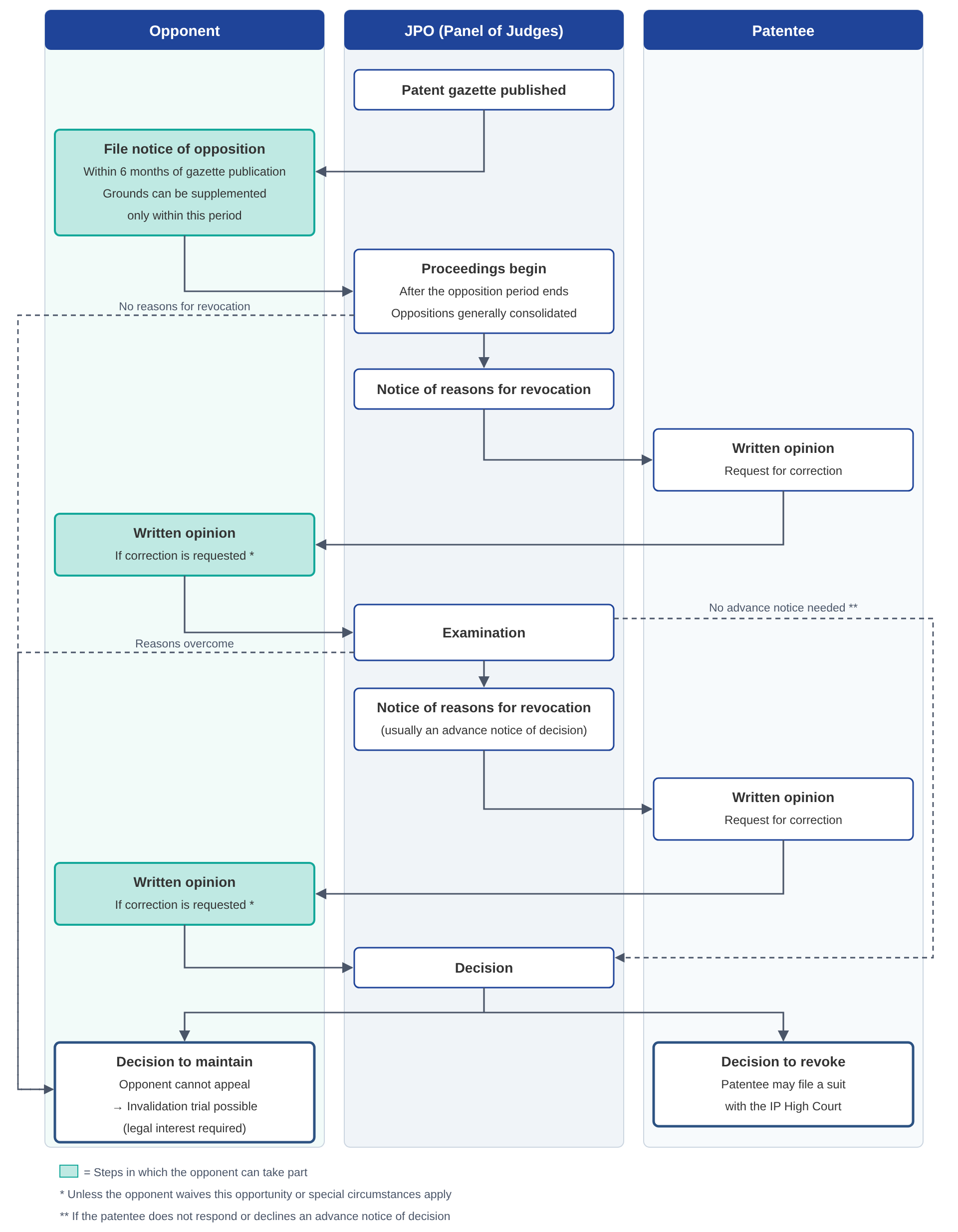
Figure 1: Flow of post-grant opposition proceedings and the opponent’s role
In principle, the proceedings start after the opposition period ends, and multiple oppositions against the same patent are generally consolidated. If the panel concludes that the patent should be revoked, it sends a notice of reasons for revocation to the patentee. The patentee may then submit a written opinion or file a request for correction. In principle, the second notice of reasons for revocation is issued as an “advance notice of decision.” If there are no reasons for revocation, or if the reasons are overcome through correction or otherwise, the panel issues a decision to maintain the patent.
A post-grant opposition is an ex parte proceeding conducted between the JPO and the patentee. After filing, the opponent’s role is mainly limited to submitting a written opinion when the patentee files a request for correction (Article 120-5(5) of the Patent Act). Even without a request for correction, the panel may send an inquiry to the opponent when necessary. Unlike in an invalidation trial, the opponent cannot argue the case as a party at an oral hearing.
3.3 Withdrawal of an Opposition
An opposition cannot be withdrawn after a notice of reasons for revocation has been issued (Article 120-4 of the Patent Act). Even if the opponent and the patentee reach a settlement, the proceedings continue to a decision, which may be a decision to revoke.
For this reason, careful consideration is needed if you intend to use an opposition as leverage in negotiations with the patentee. For that purpose, an invalidation trial may be more suitable, because the request can be withdrawn until the trial decision becomes final (Article 155(1) of the Patent Act). After the demandee has filed a written reply, the demandee’s consent is required (Article 155(2)). Note, however, that only interested parties may request an invalidation trial, and the requester’s name is disclosed.
3.4 The Decision and What Follows
| Decision | Appeal |
|---|---|
| Decision to revoke | The patentee may file a suit with the IP High Court to cancel the decision |
| Decision to maintain | The opponent cannot appeal. To continue the challenge, the opponent must request an invalidation trial (a legal interest is required) |
Table 2: Decisions and appeals
4. Comparison with Third-Party Observations and Invalidation Trials
| Item | Third-party observations | Post-grant opposition | Invalidation trial |
|---|---|---|---|
| Who can file | Any person | Any person | Interested parties only |
| Anonymous filing | Permitted | Not permitted (third-party name permitted) | Not permitted |
| Timing | While pending before the JPO (before grant) / after registration | Within 6 months from the publication date of the patent gazette | Any time after registration (even after the right lapses) |
| Main grounds | Novelty, inventive step, description requirements, etc. | Grounds of public interest (novelty, inventive step, description requirements, etc.) | Grounds of public interest + entitlement and post-grant grounds |
| Review | Considered in examination (before grant) / none (after grant) | Yes (documentary proceedings) | Yes (oral hearings in principle) |
| Involvement | None | Written opinion when a request for correction is filed | Full involvement as a party |
| Official fees | Free | JPY 16,500 + JPY 2,400 per claim | JPY 49,500 + JPY 5,500 per claim |
| Appeal | — | Not available against a decision to maintain | Either party may file a suit with the IP High Court |
Table 3: Third-party observations, post-grant opposition, and invalidation trial
For more on third-party observations, see Japanese Patent Applications: Third-Party Observations.
As a general guide (Figure 3):
- Before grant: Use anonymous, free third-party observations to have the information considered in examination
- Within 6 months after the gazette is published: Use a post-grant opposition, which is low-cost and relatively fast. A third party’s name may be used (Section 2.1)
- After the six-month opposition period, when full participation as a party is important, or when negotiations with the patentee are expected: Use an invalidation trial
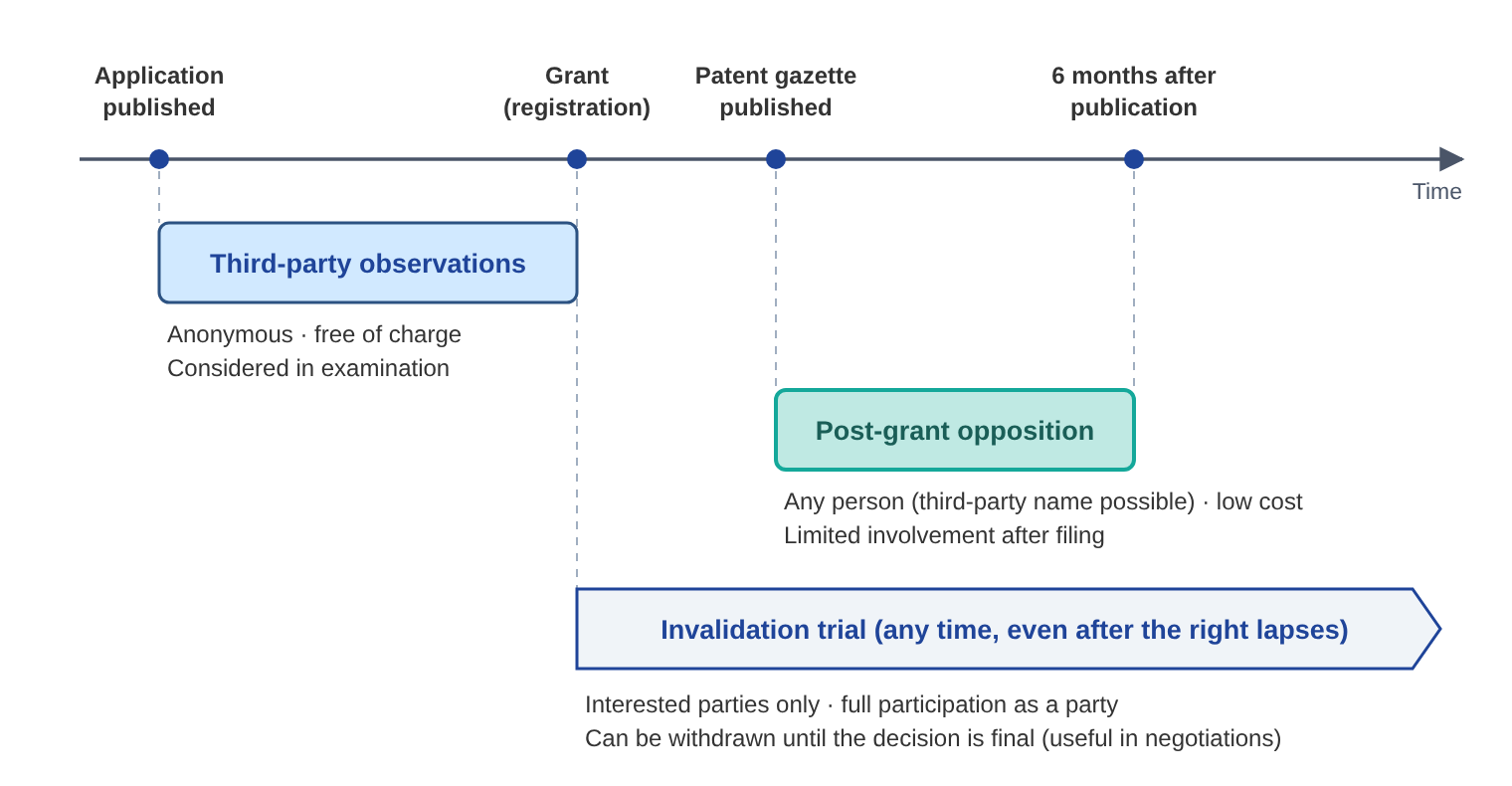
Figure 3: When to use third-party observations, post-grant opposition, and invalidation trial
5. Comparison with Other Systems: Key Differences for Prospective Opponents
For readers familiar with oppositions in Europe or with reexaminations, PGR, or IPR in the United States, the table below compares the requirements for filing.
| Japan (post-grant opposition) |
EPO (opposition) |
US (PGR / IPR) |
US (ex parte reexamination) |
|
|---|---|---|---|---|
| Time limit | 6 months from the publication date of the patent gazette | 9 months from publication of the mention of grant | PGR: 9 months from grant IPR: after the later of 9 months from grant or the end of a PGR |
Any time during the period of enforceability |
| Identity of the opponent | Third-party name permitted | Anonymous filing not permitted; straw man permitted | All real parties in interest must be identified | Anonymous filing permitted (currently) |
| Official fees | JPY 16,500 + JPY 2,400 per claim | EUR 880 | PGR: USD 59,375 IPR: USD 51,875 (up to 20 claims; total of request and post-institution fees) |
USD 6,775 (streamlined request: up to 40 pages and other format requirements) USD 13,545 (other) |
Table 4: Requirements for filing in Japan and other major systems
Reference: Fees as of November 2026. JPO; EPO “Rules relating to Fees” (applicable as from 1 April 2026); USPTO “USPTO fee schedule”
In Japan, the official fees are low, and an opposition may be filed in the name of a third party domiciled in Japan. The procedural and official-fee barriers to filing are therefore relatively low. In the United States, an ex parte reexamination may also be requested anonymously, but the grounds are limited to novelty and obviousness based on patents and printed publications. In Japan, an opposition may also be based on other grounds, such as the description requirements.
After filing, however, the Japanese system has the following features:
- Opponent’s involvement: The proceedings are documentary only, with no oral hearings. The opponent’s main opportunity to take part after filing is to submit a written opinion when the patentee files a request for correction. All arguments and evidence should therefore be presented in the notice of opposition (Sections 3.2 and 6.2).
- Settlement: An opposition cannot be withdrawn after a notice of reasons for revocation, and the proceedings continue even if the parties settle (Section 3.3).
- Appeal: The opponent cannot appeal a decision to maintain the patent (Section 3.4).
- Effect on later proceedings: The Patent Act has no estoppel provision like those for PGR and IPR. The bar under Article 167 applies only to final trial decisions in invalidation trials, not to opposition decisions. The opponent can therefore later request an invalidation trial, even on the same grounds and evidence (a legal interest is required).
- Outcomes: About 10% of cases end in a decision to revoke. Of the cases disposed of from 2015 to 2023, about 60% (including revocations) resulted in a change to the scope of the patent, mostly through corrections (Section 6.1).
6. Practical Points
6.1 Statistics on Post-Grant Oppositions
From 2017 to 2024, the number of oppositions ranged from about 1,000 to just over 1,400 per year, roughly ten times the number of invalidation trial requests (about 80 to 190 per year). The revocation rate (the share of decisions to revoke among cases disposed of in each year) has remained at around 10%. In 2025, the number of oppositions fell to 1,145 (JPO “Update on Recent Developments” (June 16, 2026)).
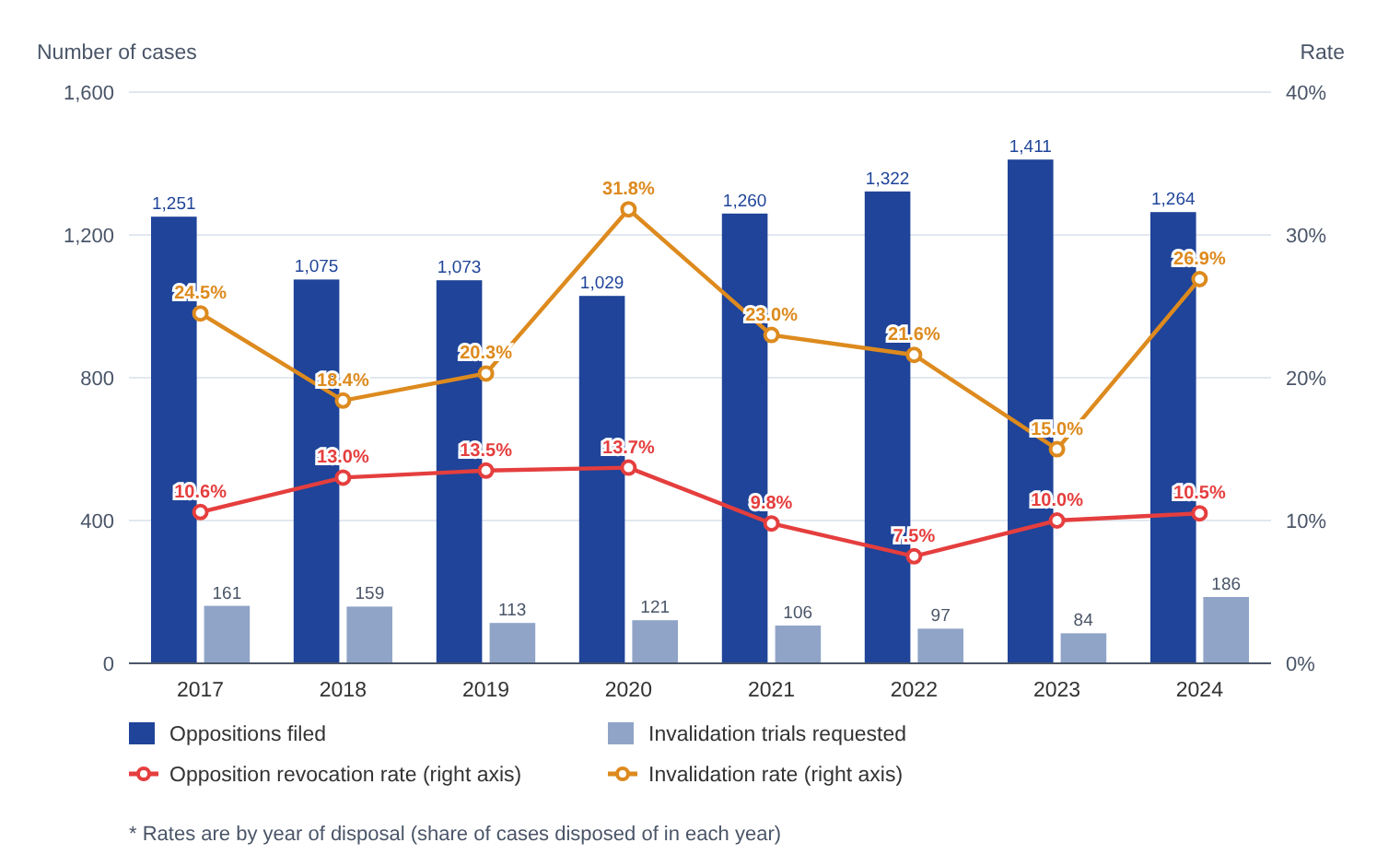
Figure 2: Number of oppositions and invalidation trials, and revocation and invalidation rates (by year of disposal, 2017–2024)
| Year | Oppositions filed | Revocation rate* | Invalidation trials requested | Invalidation rate* |
|---|---|---|---|---|
| 2017 | 1,251 | 10.6% | 161 | 24.5% |
| 2018 | 1,075 | 13.0% | 159 | 18.4% |
| 2019 | 1,073 | 13.5% | 113 | 20.3% |
| 2020 | 1,029 | 13.7% | 121 | 31.8% |
| 2021 | 1,260 | 9.8% | 106 | 23.0% |
| 2022 | 1,322 | 7.5% | 97 | 21.6% |
| 2023 | 1,411 | 10.0% | 84 | 15.0% |
| 2024 | 1,264 | 10.5% | 186 | 26.9% |
Table 5: Oppositions and invalidation trials: numbers and outcomes (2017–2024)
Notes: * By year of disposal. The number of oppositions is counted per patent. The revocation rate = decisions to revoke (including partial revocation) ÷ (decisions to revoke + decisions to maintain (including dismissals)). The invalidation rate = trial decisions invalidating the patent (including partial invalidation) ÷ (decisions invalidating + decisions not invalidating (including dismissals)). Withdrawals and abandonments are excluded. These rates show the share of cases disposed of in each year. They do not show the final probability of revocation for cases filed in that year.
Source: Prepared based on JPO “Japan Patent Office Annual Report 2025” (Statistics, data up to 2024, in Japanese), published on e-Stat
Of the cases finally disposed of between April 2015 and December 2023, 37.5% were maintained without correction, 50.5% were maintained with correction, and 10.7% were revoked (in whole or in part). Taken together, maintenance with correction, revocation, and dismissal because all opposed claims were deleted account for 62.1% of all cases. In these cases, the scope of the patent changed.
By technical field, patents in chemistry (IPC Section C) tend to be opposed more often (same source).
6.2 The Quality of the Notice of Opposition Matters
Grounds and evidence can be supplemented only within the opposition period, and the opponent has limited opportunities to comment afterwards. As a rule, all reasonably available grounds and evidence should be presented when the opposition is filed.
After the opposition period, documents can still be submitted through a post-grant information submission (statement of submission of publications). However, according to the Manual for Trial and Appeal Proceedings, documents submitted after the opposition period will not be used as evidence unless it is obvious at first glance that they constitute an appropriate reason for revocation (Manual 67-05).
6.3 Typical Duration
| Procedure | 2024 | 2025 |
|---|---|---|
| Post-grant opposition (patents) | 7.9 months | 8.3 months |
| Invalidation trial (patents and utility models) | 15.1 months | 13.9 months |
Table 6: Average pendency (2024 and 2025)
Sources: 2024: JPO “Japan Patent Office Annual Report 2025” (Statistics, Chapter 2, in Japanese); 2025: JPO “Update on Recent Developments” (June 16, 2026)
Note: The JPO measures pendency from the filing date of the opposition (or of the request for an invalidation trial) to the dispatch of the decision. Where an advance notice of decision (or, in an invalidation trial, an advance notice of trial decision) is issued, the end point is the dispatch of that notice.
Oppositions tend to be decided faster than invalidation trials. When estimating the total time from the publication of the gazette, note two points. First, the period from the publication of the gazette to the filing of the opposition (up to six months) is not included. Second, where an advance notice of decision is issued, the final decision comes after the patentee responds, so it takes longer than the average pendency. As a rough estimate, if you file near the end of the opposition period, expect a decision about 14 months or more after the gazette is published.
7. Frequently Asked Questions (FAQ)
Please note that this article is based on the information available and the applicable laws and regulations in effect as of the date of publication. While every effort has been made to ensure the accuracy of the information provided, no guarantee is made as to its completeness or accuracy. We assume no liability whatsoever for any loss or damage arising out of or in connection with the contents of this article. This article is provided for general informational purposes only and does not constitute legal advice. Before taking any action in a specific case, we strongly recommend consulting a qualified professional, such as a patent attorney.