

Japanese Patent Applications: Third-Party Observations | Timing, Anonymity, Fees, and Eligible Grounds
2026.10.06

Tatsuyuki TSUBO
If you believe that an invention claimed in a competitor’s Japanese patent application is already known, you can bring the relevant information to the examiner’s attention through the third-party observation system (Article 13bis of the Regulations under the Patent Act). In Japan, this procedure is also called “information submission.” It is broadly comparable to third-party observations before the EPO (Article 115 EPC) and preissuance submissions before the USPTO (35 U.S.C. § 122(e)). Anyone may file observations anonymously and without paying any official fee to the JPO.
However, observations must be filed before the decision to grant, at a time when the examiner can still take them into account.
This article summarizes the key points: when to file, who can file, anonymity, eligible grounds for refusal, and fees.
- Anyone can file. Anonymous filing is permitted
- No official JPO fees are charged
- Observations must be filed before the decision to grant, at a time when the examiner can still consider them. Third parties cannot contact the examiner (for example, to ask when examination will start or to ask the examiner to wait)
- After grant, consider a post-grant opposition or an invalidation trial
- Eligible grounds include lack of novelty, lack of inventive step, and description requirements. Lack of unity and usurped applications are not eligible grounds
1. Overview of the Third-Party Observation System
| Item | Details |
|---|---|
| Who can file | Anyone (anonymous filing permitted) |
| When to file | Any time while the application is pending before the JPO, whether or not examination has been requested. There is no limit on the number of submissions. However, the information should be submitted early enough for the examiner to consider it before preparing the relevant office action. Information submitted after the decision to grant will not be considered during the examination. |
| Scope | Information on specified grounds for refusal, such as lack of novelty, lack of inventive step, and description requirements |
| Fees | No official JPO fees are charged |
| Notice to the applicant | Yes (if the submission is anonymous, the submitter is not identified) |
Table 1: Overview of the third-party observation system
Reference: JPO “Submission of Observations from Third Parties” (English) / JPO「情報提供制度」(Japanese)
2. When Can Observations Be Filed?
File Before the Decision to Grant, Ideally Before the First Office Action
Observations can be filed at any time after the application is filed, as long as it is pending before the JPO, whether or not examination has been requested. There is no limit on the number of submissions. In practice, however, third parties cannot see an application before it is published, so observations are filed after publication.
Note that being able to file is different from having the information considered. Information submitted after the decision to grant will not be considered during the examination. Observations may still be filed after the first notification of reasons for refusal (first office action) or after the applicant responds. To maximize the likelihood that the information will be considered, however, observations should ideally be filed after the request for examination and sufficiently before the examiner prepares the first office action.
Third parties who file observations do not become parties to the examination, so they cannot contact the examiner. They cannot ask the examiner when examination will start, or ask the examiner to wait for their submission. Early filing is therefore important.
After Grant: Post-Grant Opposition or Invalidation Trial
To challenge the validity of a patent after grant, consider a post-grant opposition or an invalidation trial.
| Post-grant opposition | Invalidation trial | |
|---|---|---|
| Who can file | Any person | Interested parties only |
| Time limit | Within 6 months from the issue date of the patent gazette | Any time after registration |
| Anonymous filing | Not permitted | Not permitted |
Table 2: Post-grant opposition vs. invalidation trial
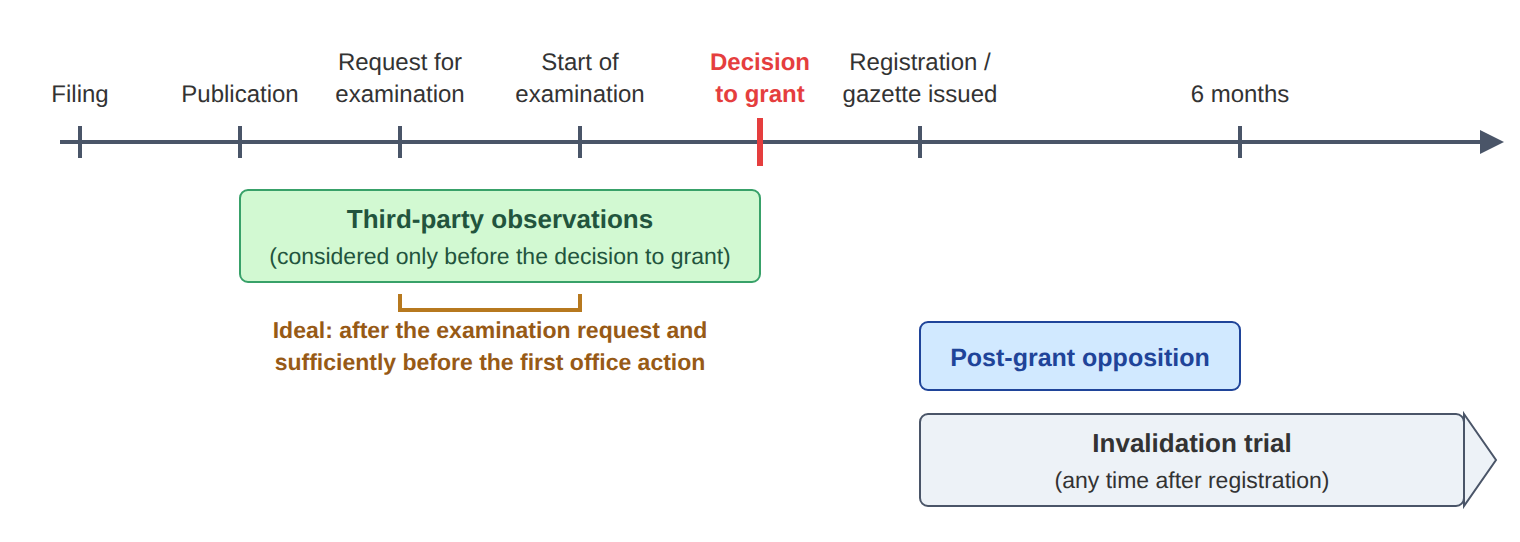
Figure 1: Timing of third-party observations, post-grant opposition, and invalidation trial
Under the Japanese system, documents filed as third-party observations may be filed again in a later post-grant opposition or invalidation trial.
In the United States, the USPTO may decline to institute an IPR because the same or substantially the same prior art or arguments were previously presented to the Office (35 U.S.C. § 325(d)). Japan has no comparable mechanism.
3. Who Can File?
Anyone can file third-party observations. This includes not only competitors of the applicant but also individuals and organizations.
A person who has no domicile or residence in Japan must file through a representative (patent administrator) who is domiciled or resident in Japan. Filing through a representative can also be anonymous.
4. Can Observations Be Filed Anonymously?
Yes. You can file anonymously by entering “omitted” in the submitter’s name and address fields of the filing form (Submission of Publications, etc.). For online filings as well, information that could identify the sender, such as the identification number, is not shown in file inspection or on J-PlatPat (Japan Platform for Patent Information). The JPO also does not answer inquiries from the applicant or others about who filed.
However, the applicant is notified that observations have been filed, and the filing also appears in the file history on J-PlatPat. The applicant will not learn who filed, but will know that a third party is monitoring the application.
Also note that anonymity covers only the submitter’s identity. The filing form and the submitted documents are open to the public, and anyone can view them by requesting file inspection. Do not include information you do not want others to see, or redact it before filing. You should also remove any information that could identify the submitter, including information in the file properties of attached files (such as the author name).
5. Eligible Grounds for Refusal
Observations can be filed only on the following grounds for refusal (Article 13bis(1) of the Regulations under the Patent Act).
| Provision (Patent Act) | Ground for refusal |
|---|---|
| Art. 17bis(3) | Addition of new matter (excluding new matter beyond the translation) |
| Art. 29(1), main paragraph | Not an invention / lack of industrial applicability |
| Art. 29(1) | Lack of novelty |
| Art. 29(2) | Lack of inventive step |
| Art. 29bis | Earlier-filed application published after the filing date of the application (secret prior art) |
| Art. 39(1)–(4) | Prior application / double patenting |
| Art. 36(4)(i) | Enablement requirement and ministerial ordinance requirement |
| Art. 36(4)(ii) | Requirement to disclose prior art document information |
| Art. 36(6)(i)–(iii) | Support, clarity, and conciseness requirements |
| Art. 36bis(2) (Art. 49(vi)) | New matter beyond the original text (applications filed in a foreign language) |
Table 3: Grounds for refusal eligible for third-party observations
On the other hand, the following grounds, among others, are not eligible: lack of unity of invention (Art. 37), violation of the joint application requirement (Art. 38), and a usurped application, that is, an application filed by a person not entitled to obtain the patent (Art. 49(vii)).
In addition, for applications filed in a foreign language (foreign-language written applications under Art. 36bis, and foreign-language PCT applications entering the national phase in Japan), new matter beyond the translation is not an eligible ground. This ground applies when an amendment goes beyond what is described in the translation.
By contrast, new matter beyond the original text is an eligible ground. This ground applies when the description, claims, or drawings (that is, the translation) contain matter that goes beyond what is described in the original foreign-language text. For example, if a translation error has introduced content that is not in the original text, this can be raised through third-party observations.
6. Fees
No official JPO fees are charged for third-party observations (for paper filings, no digitization fee is charged either).
7. Frequently Asked Questions (FAQ)
Please note that this article is based on the information available and the applicable laws and regulations in effect as of the date of publication. While every effort has been made to ensure the accuracy of the information provided, no guarantee is made as to its completeness or accuracy. We assume no liability whatsoever for any loss or damage arising out of or in connection with the contents of this article. This article is provided for general informational purposes only and does not constitute legal advice. Before taking any action in a specific case, we strongly recommend consulting a qualified professional, such as a patent attorney.